
A Microsoft Word version 7.0 of this article can be
PDAs can boost productivity, cut paperworkAvailable applications can automate coding, streamlinebilling, reduce accounts receivables | 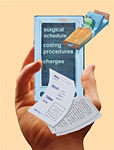 |
By Ian J. Alexander MD
As originally conceived, personal digital assistants (PDAs)were simple tools designed to handle personal information management taskssuch as keeping track of appointments, contacts and to-do lists. Today,the term PDA misrepresents the digital power of the latest handheld computers.Current handheld devices pack high-speed processors (200+ MHz), ample memory(up to a gigabyte on a flash card) and wireless connectivity that make themmobile data workhorses.
Harnessing this power with sophisticated software willlead to practice productivity enhancement with a rapid return-on-investmentthat will drive widespread implementation.
Productivity enhancing applications currently availablefor these devices include automated ICD-9 and CPT coding, point-of-carecharge capture to streamline billing and reduce accounts receivable, wirelessdata transfer both in the office and from remote locations, electronic prescribing,electronic medical records and customizable research or registry forms.These applications provide the physician a mobile means of accessing andentering patient data, and the added benefits of improved documentation,fewer coding errors, safer prescribing and less "paperwork."
The latter benefit is worth exploring in more detail. Takefor example surgical scheduling, often a labor intensive and time consumingsecretarial process. Computer-assisted scheduling allows the scheduler torapidly search for and identify appropriate time slots, automate the schedulingof frequent procedures using macros that include ICD-9 and CPT codes, andelectronically transmit the information to the surgical facility. A 20 to30 minute process can thus be reduced to 2 to 3 minutes. All this informationis transferable to the physician’s handheld device.
Thus, at anytime the physician has at his or her fingertipsthe entire surgical schedule, as well as a means of coding procedures andsubmitting charges immediately after surgery. In addition, handheld computer-basedoperative report templates, custom-built by the physician, allow instantgeneration of a narrative surgical record without dictation.
Despite the significant return-on-investment of point-of-carecharge capture, this potential is dwarfed by the savings possible with transitionto a "structured" electronic medical record system. Structuredmeans form-based and not free text. Free text electronic records are thecomputerized equivalent of your current dictated paper record and althoughthey save clerical time and improve record access, financial advantagesof this transition will be minimal. Significant saving will only be achievedwith structured records, which, in contrast to free text records, make possible:
If dictation is needed, carrying a separate voice recordingdevice isn’t necessary as some handheld devices are capable of capturingaudio files. These recordings can be entered into the note fields of anyform and subsequently transcribed into the record.
Although physicians have the most to gain through improvedefficiency and lower overhead, it’s their resistance to change thatmost often hinders information technology adoption. However, a well thoughtout implementation plan can soften resistance by making the process minimallydisruptive. First, start with a "champion," a visionary computer-savvyphysician who appreciates the potential long-term benefit and will takeownership of the project. Second, choose a software package that allowsgradual implementation, starting with charge capture and progressing toan EMR as each physician becomes comfortable with using handheld devices.Third, make sure the system allows for a parallel paper record during thetransition and accommodates physicians who insist on dictating their records.
In the final analysis a carefully planned implementationof orthopaedic surgery specific PDA-based charge capture and documentationsystems will minimize practice disruption, reduce risk and maximize potentialbenefits.
By Ian J. Alexander MD FRCS(C) is an orthopaedic surgeonand president of Aristar Inc., an Ohio software company that develops handheldcomputer applications for orthopaedic surgeons.
Computer Link welcomes suggestionsabout future topics for the column and questions about the use of computersin orthopaedic practice. Send your suggestions to the Bulletin atAAOS, 6300 N. River Rd., Rosemont, Ill. 60018 or e-mail breisch@aaos.org
